
More Than a Badge.
What Master Sign Maker Means to Sign Network
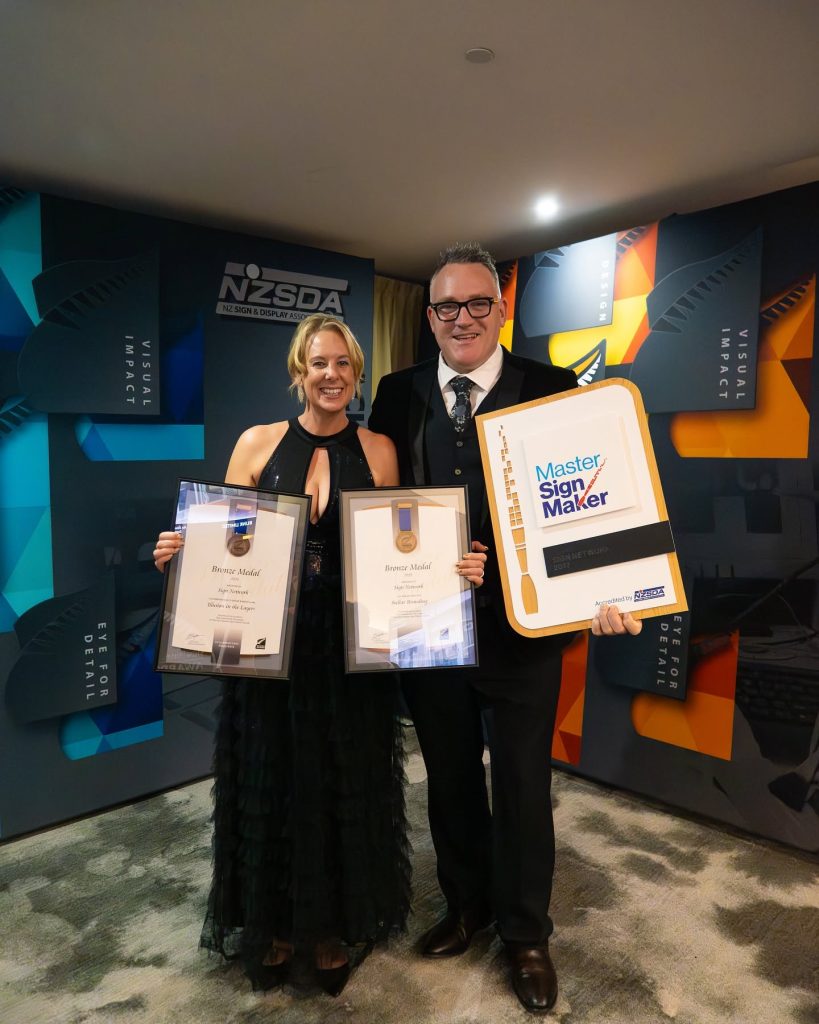
Sign Network was proud to be one of the initial 19 New Zealand sign companies awarded Master Sign Maker accreditation in 2017.
For us, becoming a Master Sign Maker was never simply about adding another logo to our website or vehicles. It was an opportunity to demonstrate that our business had been independently assessed against a recognised industry standard—and that our systems, workmanship, ethics and business practices reflected the level of professionalism our customers should expect from a leading sign company.
By 2022, the number of accredited Master Sign Makers had reduced to only 10 nationwide. This was not necessarily because businesses had failed to maintain the required standard. Retirement, ownership changes and the sale or closure of established sign companies had gradually reduced the group.
Over the past two years, however, there has been a real resurgence in the programme. More than 30 businesses are now accredited or progressing through various stages of the Master Sign Maker pathway.
That momentum is important—not only for the businesses involved, but for the future credibility and professionalism of the entire New Zealand sign industry.
Why we became a Master Sign Maker
Sign-making is an incredibly diverse industry.
It encompasses traditional craftsmanship, graphic design, branding, digital printing, fabrication, illumination, engineering, vehicle graphics, wayfinding, project management and complex installation work. The technology, materials and compliance requirements involved continue to evolve rapidly.
Good sign businesses invest heavily in their people, equipment, systems, health and safety, training and technical capability. They work hard to produce quality outcomes, stand behind their workmanship and build long-term trust with their customers.
However, customers do not always have an easy way to identify those businesses.
From the outside, it can be difficult to distinguish between a professional, well-managed sign company and an operator offering what appears to be the same product at a lower price. The differences often only become apparent after something goes wrong.
Master Sign Maker provides a way to demonstrate that difference.
The accreditation assesses more than the appearance of the finished sign. It considers the business behind the work—its capability, reliability, workmanship, systems, ethics, safety practices and commitment to the industry.
For Sign Network, that aligns strongly with how we want to operate and how we want to be seen.
Why we became a Master Sign Maker
Sign-making is an incredibly diverse industry.
It encompasses traditional craftsmanship, graphic design, branding, digital printing, fabrication, illumination, engineering, vehicle graphics, wayfinding, project management and complex installation work. The technology, materials and compliance requirements involved continue to evolve rapidly.
Good sign businesses invest heavily in their people, equipment, systems, health and safety, training and technical capability. They work hard to produce quality outcomes, stand behind their workmanship and build long-term trust with their customers.
However, customers do not always have an easy way to identify those businesses.
From the outside, it can be difficult to distinguish between a professional, well-managed sign company and an operator offering what appears to be the same product at a lower price. The differences often only become apparent after something goes wrong.
Master Sign Maker provides a way to demonstrate that difference.
The accreditation assesses more than the appearance of the finished sign. It considers the business behind the work—its capability, reliability, workmanship, systems, ethics, safety practices and commitment to the industry.
For Sign Network, that aligns strongly with how we want to operate and how we want to be seen.
The commercial opportunity
The greatest potential value of Master Sign Maker has not yet been fully realised.
At present, awareness outside the sign industry remains limited. While individual accredited businesses can use MSM to strengthen their own credibility, its real commercial power will emerge when it becomes widely recognised by customers, councils, architects, construction companies, agencies, procurement teams and professional specifiers.
For that to happen, the programme needs scale.
If more than 100 reputable sign businesses throughout New Zealand held or were actively progressing toward Master Sign Maker accreditation, MSM could become a genuine industry standard.
It could give specifiers a credible benchmark when preparing tenders. Councils and larger organisations could use it as evidence of capability and professional practice. Agencies could confidently recommend accredited providers. Customers could actively look for the Master Sign Maker brand when choosing who to trust with their signage.
That is when MSM moves from being an advantage held by a small number of companies to becoming a recognised mark that influences purchasing decisions.
Importantly, increasing the number of accredited businesses does not mean lowering the standard. The value comes from making the pathway achievable and well supported while retaining a robust and credible assessment process.
The goal should be to bring more good sign companies up to the standard—not to make the standard exclusive for the sake of exclusivity.


Stronger businesses create a stronger industry
It would be easy to look at MSM purely through a competitive lens. If accreditation helps Sign Network stand out, why would we want more competitors to have it?
The answer is that a stronger and more professional industry benefits all reputable operators.
When customers have poor experiences with signage providers, it damages confidence in the entire industry. When businesses compete primarily on price without understanding materials, compliance, installation risks or long-term performance, everyone’s work becomes harder to value.
Master Sign Maker creates an opportunity to establish clearer expectations around what professional sign-making looks like.
A larger network of accredited businesses would help improve consistency, lift customer confidence and give the industry a stronger collective voice. It would also create a recognised pathway for businesses that want to improve their systems, strengthen their capability and demonstrate their commitment to good practice.
We do not see the growth of MSM as weakening the advantage of our accreditation. We see it as making that accreditation more valuable.
The more credible businesses that stand behind the mark, the more recognised and influential the mark can become.
Our challenge to other sign businesses
If your business is eligible for the Master Sign Maker pathway, we encourage you to take the next step.
Do not approach it as a box-ticking exercise or simply another annual membership cost. Use the process as an opportunity to look honestly at your business, identify areas for improvement and demonstrate the standards you already work hard to maintain.
The programme is being refreshed and strengthened. It now has renewed momentum, clearer positioning and a growing group of businesses committed to seeing it succeed.
Sign Network intends to maintain its Master Sign Maker status indefinitely. We are proud to have been part of the original group, but we are even more interested in what MSM can become from here.
Our ambition should be for Master Sign Maker to become the recognised standard for professional sign businesses in New Zealand.
That will only happen if enough of the industry gets behind it.
For individual businesses, accreditation provides credibility, accountability and a valuable point of difference. Collectively, it gives us the opportunity to raise expectations, strengthen customer confidence and improve the standing of the entire New Zealand sign industry.
That is why Master Sign Maker matters to us—and why we want to see many more businesses complete the pathway.