
President's Post - August 2026
It’s been a busy month. I’ve had my head down with plenty going on in my own business, as I’m sure many of you can relate to.
But amongst the busyness, I’ve still managed to catch up and have a few good conversations with fellow signies. I enjoy hearing about what’s going well, but probably even more, I enjoy hearing about the challenges people are working through. As they say, a problem shared is a problem halved – and quite often someone else has already faced the exact same issue and learnt something from it.
A couple of those conversations lately have been around signs that simply haven’t lasted as long as expected.
You see, sometimes the problem isn’t necessarily what we’ve used. It’s where we’ve used it.
My shop is based in New Plymouth, and we do work right around the mountain. One thing 25 years of doing this has taught me is that the sign I make on the other side of the mountain is quite likely going to be different from the sign I make here, where our main street is only about 500 metres from the Tasman Sea.
Salt gets into everything. Something that might happily last seven or ten years inland can start looking pretty average surprisingly quickly near the sea.
So, here are a few of my DO NOTs for exterior signage in coastal environments:
- Zinc Screws? Just Don’t.
This one blows my mind with how often I see it.
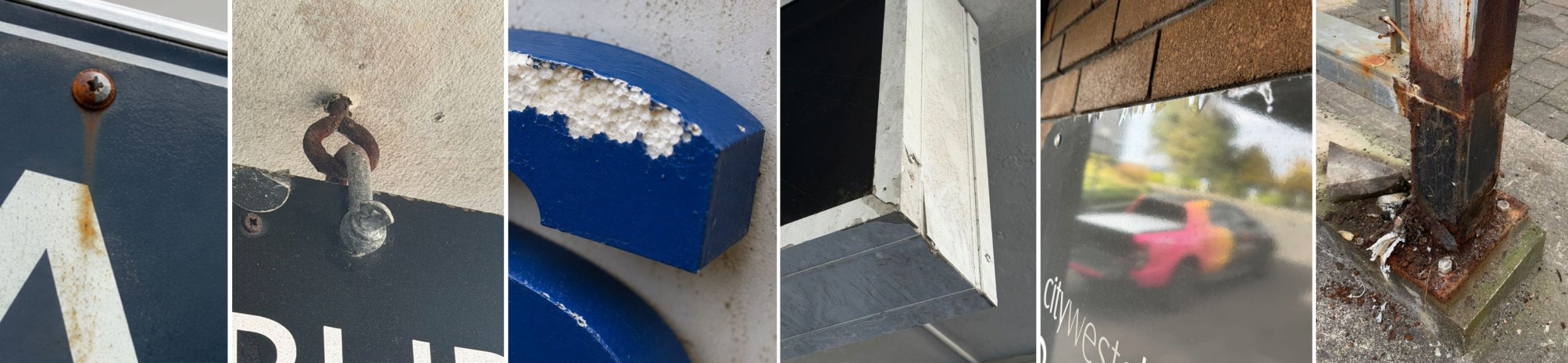
You make a beautiful new sign, install it near the coast, and before long those screws start rusting, leaving horrible brown streaks down the face.
The sign might be absolutely fine. It’s the few dollars’ worth of fixings holding it up that let the whole job down.
Use quality stainless fixings suitable for the environment. Simple.
- Don’t Let the Hardware Let You Down
The same goes for galvanised eyebolts and D-shackles on under-verandah signs.
They might look fine when the sign goes up, but give them a few years of salty air and it’s a different story. They rust, stain and deteriorate.
More importantly, they’re part of what is holding that sign above people’s heads.
If we expect the sign to last, the hardware holding it up needs to last too.
- Seagulls Love Polystyrene. Your Sign Won’t.
I remember a local shop getting brand-new dimensional signs many years ago. They looked stunning, all painted up in navy and red.
Within a few months, the seagulls had pecked away at the edges, revealing the white foam underneath. A three-month-old sign suddenly looked ten years old.
It’s funny now. I suspect the shop owner didn’t find it quite so funny at the time.
If you’re going to use polystyrene outside, particularly around the coast, make sure it is properly protected with an appropriate coating system.
- Raw Aluminium and Paint Don’t Mix
I see this on aluminium letters, lightboxes and tavern-style blade signs far too often.
The paint starts bubbling and eventually flakes away, and what was once a tidy sign looks rough well before its time.
Preparation matters. Degrease it properly, etch prime it, then use a suitable paint system.
Just because aluminium doesn’t rust like steel doesn’t mean you can throw some paint over it and she’ll be right. Salt will soon prove otherwise.
- Protect Those ACM Edges
This would have to be one of the biggest offenders I see.
ACM is everywhere in our industry, and for good reason. But on exterior signage, particularly shop fascias, think about those cut edges.
A cut edge facing upwards becomes a perfect little shelf for moisture, salt and grime. Once corrosion gets into that exposed aluminium edge, you can end up with bubbling and delamination.
A sign that might give you seven-plus years inland can have its life dramatically shortened beside the sea.
Fold it, cap it, protect it or detail it differently. Just don’t leave that edge sitting there hoping for the best.
- Mild Steel Can Become More Than an Ugly Problem
I’ve seen lightboxes, plinth signs and other sign structures fabricated from mild-steel hollow section with steel plates welded onto them, then painted and installed near the coast.
They look great when they’re new.
Then the corrosion starts.
The plates begin blowing out, rust appears around the welds and joints, and the connection between the hollow section and steel plate starts corroding away.
Now we’re not just talking about appearance. We potentially have a safety issue.
A freestanding sign blowing over or a projecting sign coming away from a building isn’t just a callback. It can hurt someone.
We need to think about the whole life of the structure, not just how good it looks when we drive away from the installation.
Make the Sign for Where It’s Going
Twenty-five years of making signs around Taranaki has taught me plenty – sometimes through getting it right, and sometimes through getting it wrong. And I’m still learning.
I think that’s one of the strengths of our industry. We talk, we share what works and what doesn’t, and hopefully we all get a little better because of it.
So next time you’re quoting an exterior sign, there’s one extra question worth asking:
“Where is this sign going to live?”
Because sometimes the smallest change in how we make it today can add years to the life of the sign.
Logan Sutton
Creative Director – Future Grafix
President – NZ Sign & Display Association